
Cash Out Safely: What Is the Tax for Selling Rental Property Costing You?
Selling a long-term rental property can be a great financial move, but it’s important to understand the tax implications that come with it. Let’s break down the two main tax considerations you’ll face: capital gains tax and depreciation recapture. Knowing how these work will help you plan better and avoid any surprises when tax season rolls around.
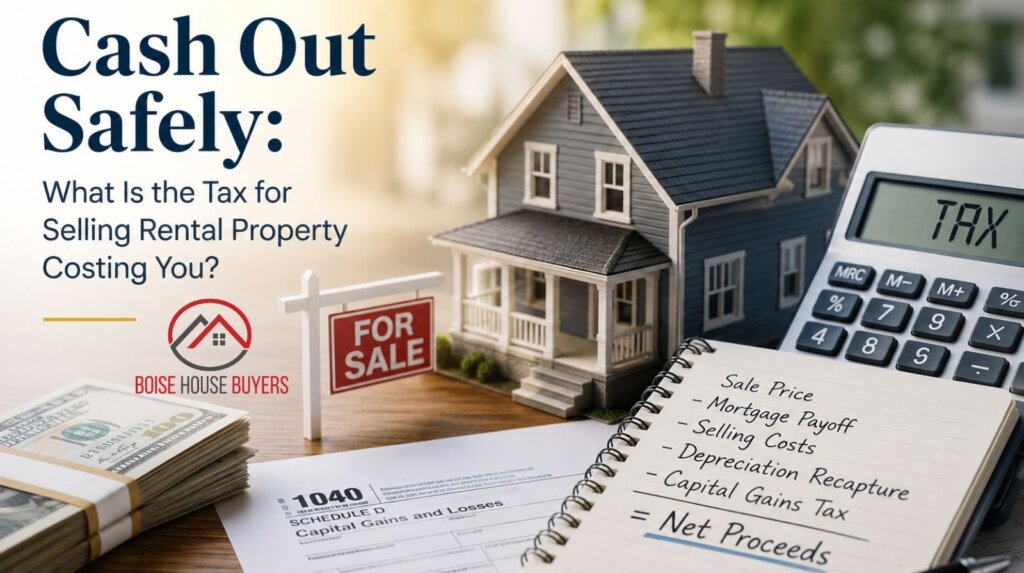
1. Capital Gains Tax: What Is It and How Does It Work?
When you sell a rental property, if the sale price exceeds your original purchase price (adjusted for certain improvements), the difference is called a capital gain. Because rental properties are considered investment assets, this gain is subject to capital gains tax.
- Long-Term vs. Short-Term: Since you mentioned a long-term rental property, this means you’ve owned it for more than one year. Long-term capital gains generally enjoy lower tax rates than short-term gains (which apply if you owned the property for less than a year).
- Tax Rates: The long-term capital gains tax rates typically range from 0%, 15%, or 20%, depending on your taxable income and filing status. For most people, 15% is the common rate, but high earners may pay 20%.
- Adjusted Basis: Your capital gain isn’t simply sale price minus purchase price. You adjust your basis by adding costs of improvements and subtracting depreciation taken over the years (more on that next).
2. Depreciation Recapture: What Is It and Why Does It Matter?
One of the perks of owning a rental property is that you can deduct depreciation expenses each year — essentially accounting for wear and tear or obsolescence of the property. However, when you sell:
- The IRS “recaptures” the total depreciation deductions you claimed.
- This recaptured amount is taxed at a special rate known as depreciation recapture tax, which maxes out at 25%.
- Even if your overall capital gain is taxed at a lower rate, the portion attributable to depreciation gets taxed at this higher 25% rate.
Sell Your House, Stress-Free! To A Company With Proven Records…
We buy houses in ANY CONDITION in Idaho. There are no commissions or fees and no obligation whatsoever. Start below by giving us a bit of information about your property or call (208)314-1350…
3. How Your Income and Filing Status Impact These Taxes
Your overall income affects which tax brackets you fall into for both capital gains and depreciation recapture:
- If you’re in a lower income bracket, your long-term capital gains tax rate could be 0%, but depreciation recapture still applies at up to 25%.
- Married couples filing jointly may have different thresholds compared to single filers.
- Additionally, if your income is very high, you might also owe the Net Investment Income Tax (NIIT) of 3.8% on your investment income, including capital gains.
4. Other Considerations
- Adjusted Basis: Your “basis” in the property is generally what you paid plus improvements minus depreciation claimed. This affects your capital gain calculation.
- Selling Expenses: Costs like real estate commissions and closing fees reduce your gain.
- State Taxes: Don’t forget state capital gains taxes vary widely.
- 1031 Exchange: If you reinvest proceeds into another similar property through a 1031 exchange, you can defer paying these taxes.
Putting It All Together: An Example
Let’s say you bought a rental property for $200,000 and over time claimed $30,000 in depreciation deductions. You sell the property for $300,000.
- Your adjusted basis is $200,000 (purchase price) – $30,000 (depreciation) = $170,000.
- Your total gain is $300,000 (sale price) – $170,000 (adjusted basis) = $130,000.
- Of this $130,000 gain:
- $30,000 (the depreciation taken) is subject to depreciation recapture taxed at up to 25%.
- The remaining $100,000 gain is taxed at your applicable long-term capital gains tax rate.
Sell Your House, Stress-Free! To A Company With Proven Records…
We buy houses in ANY CONDITION in Idaho. There are no commissions or fees and no obligation whatsoever. Start below by giving us a bit of information about your property or call (208)314-1350…
In Summary
Selling a long-term rental property triggers two main taxes:
- Capital Gains Tax on the profit made from the sale (after adjustments).
- Depreciation Recapture Tax on the total depreciation deductions taken over time.
The rates vary based on your income, filing status, and other factors. Planning ahead — possibly with the help of a tax professional — can help minimize your tax liability and maximize your net proceeds from the sale.
If you’re thinking about selling your rental property soon, it’s definitely worth consulting with a CPA or tax advisor who can crunch the numbers specific to your situation and suggest strategies like timing your sale or using a 1031 exchange to optimize your tax outcome.
Feel free to ask if you want me to break down any part in more detail!